
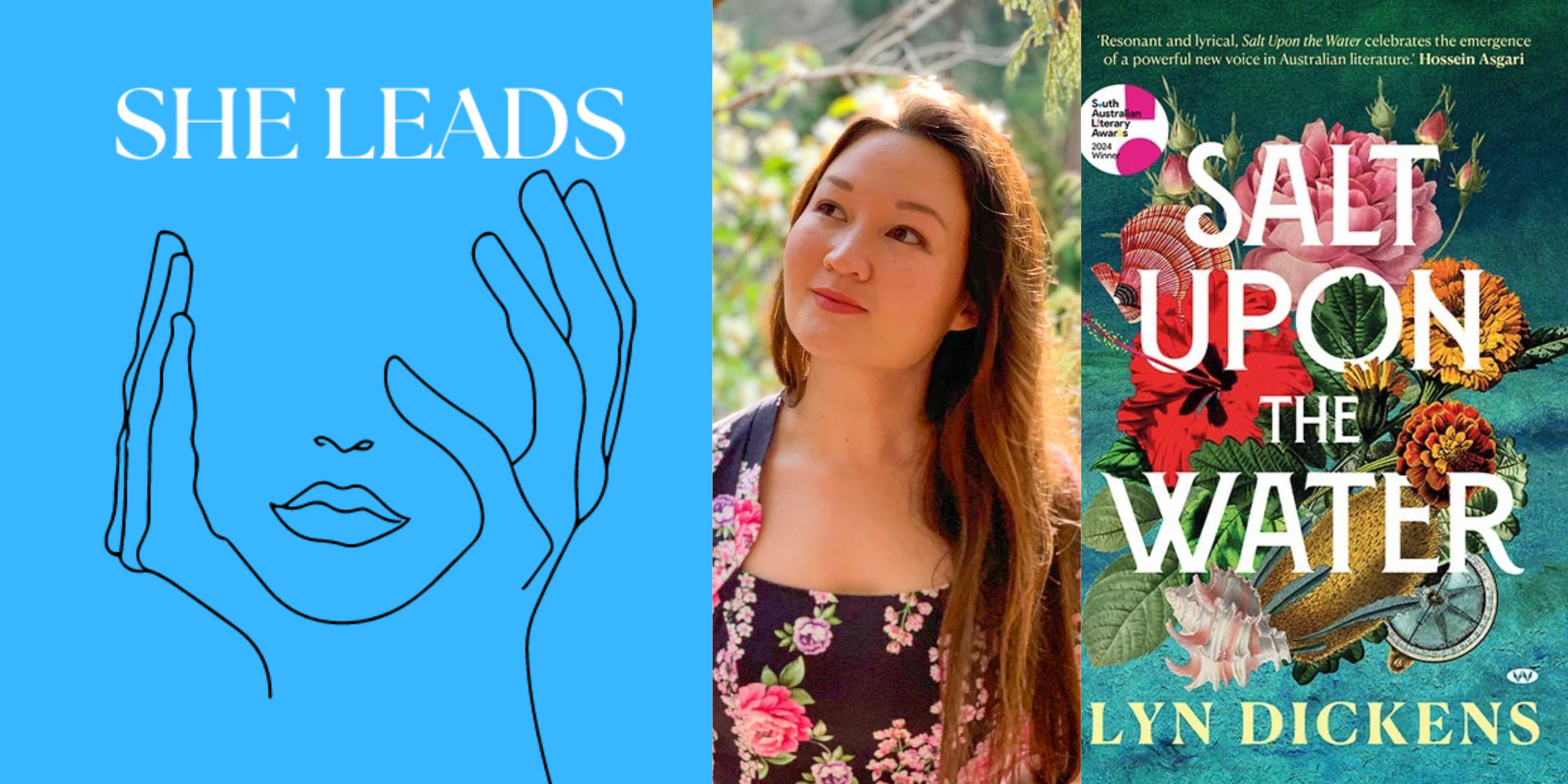
Written by Emma Pei Yin
When you talk to Lyn Dickens, you get the sense that her stories have been simmering for a long time. Salt Upon the Water moves through London, Calcutta, Penang and early colonial South Australia, yet the heart of it feels close, almost intimate. The novel began the moment she saw a self-portrait of Colonel William Light. She told me that something shifted inside her when she learned about his mixed English and Southeast Asia ancestry. In her words, it
“felt like the ground shifted beneath my feet.”
It opened a different way of imagining where Asian Australian stories begin.

Light’s life showed her that Australia’s past is more complicated than the narrow colonial version many of us grew up with. He was well travelled, creative and cosmopolitan, and Lyn wondered what it meant for him to be read differently in each place he lived. She asked herself what it meant for someone to be both colonised, and a coloniser, and how that tension might have shaped him before he ever stepped onto Kaurna land. That question fuels much of the book’s energy.
At the centre of the novel is Clarissa FitzRoy, a mixed heritage woman whose defiance quietly anchors the story. Lyn said she wanted Clarissa to resist the tendency for people to flatten complex identities into one simple category.
“Given the complexity of Southeast Asian hybridised communities, there has often been a sense that these identities need to be flattened,” she explained.
“The character of Clarissa resists this, and I found that resistance great to write.”
Her own feelings of diasporic loss filtered through Clarissa as well, especially the ache of losing language and searching for the threads of her grandmother’s world.

Inheritance, in Lyn’s hands, is never tidy. It is shaped by love, loss, silence and power all at once. She said it is something Clarissa and Light cannot resolve, and that felt honest to her.
“We carry histories of power, love, violence and loss in our bodies,” she said. “So much of that becomes a negotiation of how to live ethically.” Her honesty about not having the answers gives the novel its emotional truth.
Lyn worked carefully with the archive, fully aware of how colonial bias shapes what survives. She felt this most strongly when she researched Light’s mother, a woman whose ancestry British historians struggled to understand.
“It was believable to me that Light’s mother may have had all of those ancestries at once,” she said, referring to the mix of Thai, Malay, Portuguese, Peranakan and Chinese heritage suggested across different sources.
Her own dual heritage helped her trust that complexity, rather than simplifying it to make the history neater. One noticeable trait of her writing is the lyrical rhythm of her prose. Lyn explained that this was intentional, a way of challenging colonial expectations of realism. She wanted her language to open up a different way of seeing, one that reflects the fluidity of mixed heritage life.

Salt Upon the Water sits comfortably in the growing field of Asian Australian literature, yet it also asks harder questions about belonging. Lyn talked warmly about books like When Sleeping Women Wake and Until the Red Leaves Fall, saying they would have changed her life had she read them when she was younger. Her own novel contributes to this widening conversation by questioning how difference is used, excluded or absorbed into national narratives.
When I asked what she hopes readers take away from the book, she returned to the themes closest to her heart.
“Love, family, identity, resistance, and how we make ethical choices in challenging conditions.”
She wants readers to rethink how they imagine social progress, reminding us that equality is not a straight line but a constant struggle. Above all, she hopes the novel encourages people to sit in complexity.
Lyn Dickens writes from the shifting spaces where history meets lived experience. Salt Upon the Water invites us into that space, asking us to sit with the messy, beautiful reality of who we are and who we come from.
To learn more about Lyn Dickens, visit: https://lyndickens.com/
SHE LEADS is a newly branded series which aims at uplifting and empowering Asian Australian women in business, creative and other different sectors.


Leave a Reply